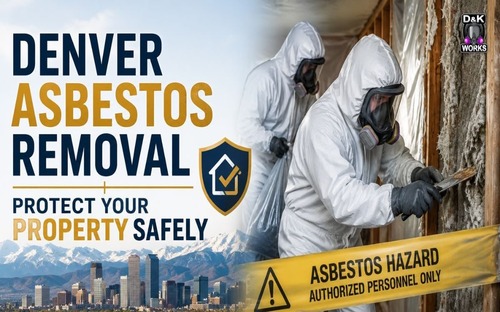
Summary – The blog guides Denver homeowners through asbestos basics, what it is, health risks, testing, removal vs. encapsulation, and the professional removal process. It closes by highlighting D&K Works Asbestos Removal’s credentials with a clear CTA, plus 5 FAQs covering cost, safety, and timeline questions.
Picture this: you’re finally ready to knock down that old wall, rip up the dated flooring, or fix up a room in your Denver home. Then someone mentions the word “asbestos,” and suddenly the whole project feels a lot more complicated.
You’re not alone. It’s one of the most common concerns homeowners run into with older properties. Is it dangerous? Do you need to move out? Can you handle it yourself, or does it call for a professional? The uncertainty alone can bring a renovation to a screeching halt.
Here’s the reassuring part: asbestos is manageable. Thousands of Denver properties have it, and thousands of owners have dealt with it safely by learning a few key facts and calling in the right help at the right time. This guide walks you through exactly that what asbestos is, where it hides, why it matters for your health, and how a trusted Denver asbestos removal company handles the process from inspection to final cleanup.
Asbestos is a natural mineral, and for most of the 20th century, it was a builder’s best friend. It resists heat, fire, and wear like almost nothing else, which is why it ended up in so many homes, schools, and offices built before the 1980s.
Here’s the twist: sitting quietly and undisturbed, asbestos usually isn’t dangerous. The real trouble starts the moment it gets cut, drilled, or crushed, during a remodel, a repair, or storm damage. That’s when invisible fibers slip into the air. You won’t see or smell them, but breathing them in can cause serious harm over time.
Asbestos fibers can scar the lungs, cause breathing trouble, and in some cases lead to cancer, including mesothelioma, a disease almost exclusively linked to asbestos. Symptoms often don’t appear until 20 to 40 years later, which is why so many people underestimate the risk sitting in their own walls today.
It’s not just construction crews at risk. A single unsafe DIY repair can put homeowners, kids, and pets in the path of airborne fibers, which is why professionals insist on testing before anyone touches a thing.
Not all asbestos carries the same level of risk, and knowing the difference helps you understand why some situations need urgent attention while others don’t.
A trained inspector can tell you which type you’re dealing with, and that changes how the removal is handled.
Not every older building has a serious problem. But some situations call for testing before you do anything else:
Testing early protects your health and your budget. Finding asbestos mid-project can stall your work and add unexpected costs; testing first avoids that entirely.
Every project is a little different, but most professional removals follow the same core steps:
Skipping any of these steps, especially containment and clearance testing, is exactly how a small asbestos issue turns into a much bigger, more expensive one.
Cost and timeline hinge on the size of the area, the amount of material, and whether it’s friable or non-friable. A small job might wrap up in a day; larger commercial projects can stretch to a week or more.
Testing alone typically runs a few hundred to over a thousand dollars, depending on how many samples are needed. A trustworthy asbestos removal team gives you a clear, itemized estimate before work starts, no surprises later.
Not every contractor is equipped to handle asbestos safely, and the stakes are too high to gamble. Look for state licensing, AHERA certification, OSHA-compliant practices, honest communication, and a solid track record across residential and commercial properties.
This is exactly where D&K Works Asbestos Removal and Mold Remediation stands out. As a family-owned, Colorado state-licensed, AHERA-certified company for Denver asbestos removal, D&K Works has spent years helping homeowners and businesses handle asbestos safely, along with related concerns like mold, lead, and crawl space contamination. Free onsite assessments and 24/7 emergency response mean you’re never left guessing what to do next.
Asbestos doesn’t have to derail your renovation or your peace of mind. Once you know what it is, where it hides, and why professional handling matters, you’re in a much stronger position to protect your property. The safest path is always the same, test first, then bring in trained professionals.
If you suspect asbestos in your Denver-area property, don’t wait for a small problem to turn into a costly one. D&K Works Asbestos Removal and Mold Remediation offers free onsite assessments, licensed and AHERA-certified crews, and 24/7 emergency service across Denver. Contact D&K Works today at 303.818.7820 to schedule your assessment.
You cannot identify asbestos by sight alone. A certified asbestos inspector must collect samples and have them tested in a laboratory to confirm whether asbestos-containing materials are present.
No. Removing asbestos without proper training and equipment can release dangerous fibers into the air. It is safest and often legally required to hire a licensed asbestos abatement professional.
The cost depends on the size of the affected area, the type of asbestos-containing material, and the complexity of the project. A professional inspection is the best way to receive an accurate estimate.
Stop all work in the affected area immediately and contact a licensed asbestos abatement company. They will inspect the material, confirm whether asbestos is present, and safely manage the removal process.
The timeline depends on the size and complexity of the project. Small residential jobs may take a day, while larger commercial asbestos removal projects can require several days or longer.


D&K is a small but growing family owned business that was established in 2010.